There is no opportunity to visit gym, but want to look healthy and beautiful? Start with a plank! Just a few minutes a day, and your body will become more toned, endurance and healthy! Thanks to the plank, the process in the digestive and excretory systems is normalized, blood circulation is improved, and muscles are strengthened.
What is a plank?
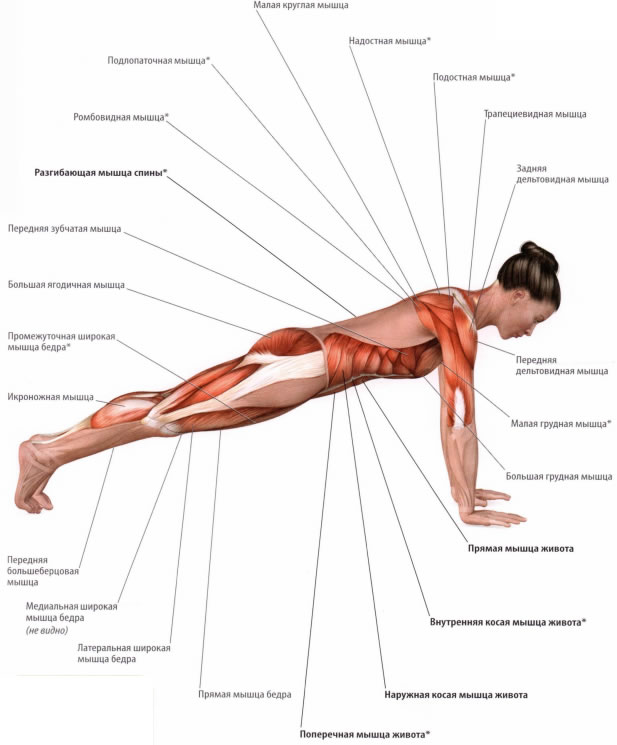
The plank consists of once a day, leaning only on your arms and toes, raising your body above the floor for a few seconds/minutes. In this state, of course, it is not very easy to survive.But almost all muscles work at once!
How to hold the bar correctly?
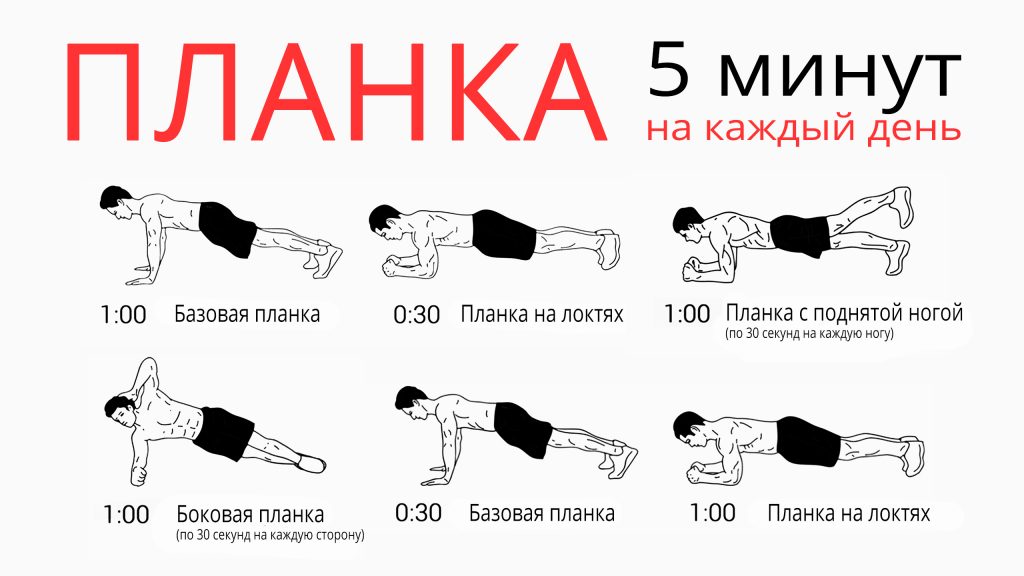
It is most convenient to perform the plank on a mat or soft and dense carpet to avoid pain. You should not eat for an hour before or after the exercise. It’s better to start with the classic plank. There are two types of it: with a stand on the elbows and on outstretched arms. The latter is believed to be more complex. It uses the arm muscles to the full extent, and increases the load on other muscle groups.
Also, the complexity of the exercise depends on the position of the legs: the wider the feet are, the easier it is to stand for a given time. To perform the plank correctly, you need to lie on your stomach. Raise the body so that the emphasis remains only on the elbows and toes. In this case, the elbows are strictly under the shoulders and form an angle of 90° with the floor.
This exercise works well and strengthens the deep muscles. These are the ones that support our heart, liver, kidneys and other internal organs.
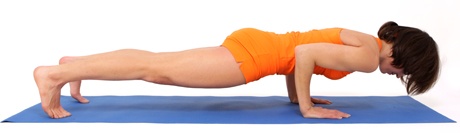
If we perform the plank with outstretched arms, we position the hands so that the middle fingers of both hands are parallel to each other and strictly in a straight line. We press our fingertips into the floor. The essence of the exercise is in the name itself – “plank”, i.e. the body should be in one straight line: crown, neck, back, pelvis and legs. The chin is tucked, the top of the head is pulled forward. The main thing is not to lift your neck. Do not bend in the lower back. The stomach is pulled in. The tailbone is tucked in. Breathing is smooth and deep without delay! In yoga, the exercise “chaturanga dandasana” is often used. Similar to a plank, but more difficult, since the elbows are bent at an angle of 90°. Also, in chaturanga, the hands are located at the level of the solar plexus.The figure below shows everything clearly:
chaturanga dandasana
(note: in the video below there is one flaw – the tailbone needs to be tucked in, the butt shouldn’t stick out! Otherwise, everything is correct)
In 2016, Beijing police officer Mao Weidong set a new world record. He held the bar for 8 hours. 1 min. 1 sec. Among women, the record holder in 2015 was Maria Kalimera. Its indicator is 3 hours. 31 min.
However, you should not chase a sharp increase in the duration of the exercise. The number and duration of approaches increases gradually. Remember: the main thing isregularity.
Mistakes during the plank exercise and how to avoid them
Although the plank is not the most difficult exercise, mistakes in its execution can lead to serious consequences.Most often, they forget to keep their entire body in one straight line. Thus, a raised or lowered pelvis entails changes in the lumbar spine, and an incorrect position of the head – in the cervical spine. To avoid such problems, perform the first few approaches in front of a mirror until your body gets used to the correct position. A sharp increase in approach time threatens to overstrain muscles that are not ready for this.
Important! Weakness and slight trembling during the plank are the norm! But the occurrence of aching, nagging pain, severe discomfort in the back, buttocks, and abdomen is a serious reason to stop the exercise and consult a doctor. The plank, like any other load, has its contraindications, namely: injuries, diseases of the joints, spine, postoperative and postpartum period (up to 6 months), pregnancy, hypertension. For varicose veins, a plank on a fitball, some types of dynamic and side planks are allowed.
Of course, a full workout cannot be replaced with one exercise. You can tighten your abdominal muscles with a plank, but achieving sculpted abs is not. Both the plank and abdominal exercises work similar muscle groups, but the emphasis is still different. Push-ups are also different from the plank. The latter gives, as it were, general training of the muscles, and not pumping them up. You shouldn’t count on significant weight loss due to the plank either. But it will prepare your body well for this. Have fun training! P.S: here is also a good article about the plank
[…] target muscle engagement—focus on back and biceps work rather than other muscle groups or inertia. Focus on technique and muscle work […]